How to Use SQL Backup Inside a Maintenance Plan

When you create a SQL Server Maintenance Plan using the Maintenance Plan Wizard or the Maintenance Plan Designer, the SQL Server native backup command is used to perform full, differential, and transaction log backups. But what if you want to use backup compression to reduce the size of your backups and the amount of time it takes to perform them? Or what if you want to encrypt your backups to protect your organization’s data, or make the transfer of backup files across networks fault-tolerant? If you have the SQL Server 2008 Enterprise Edition, backup compression is built in, but if you have any other version or edition of SQL Server, or if you want encryption or network resilience, then you will need a third-party backup program, such as SQL Backup from Red Gate Software.

The Maintenance Plan Wizard and the Maintenance Plan Designer don’t have the ability to automatically include third-party backup software as part of a Maintenance Plan. Fortunately, there is an easy way around this, and in this article I will show you how you can use SQL Backup within a Maintenance Plan.

Continue reading

New Article on Clustering Myths in the PASS SQL Server Standard

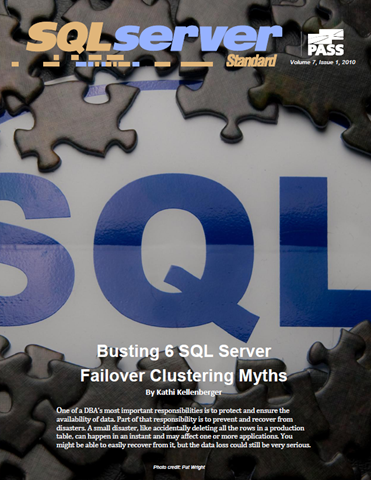
image The PASS SQL Server Standard has published a new article called “Busting 6 SQL Server Failover Clustering Myths”, by Kathi Kellenberger. You can download the free article (its in the PDF format) if you are a PASS member. If you aren’t a PASS member, you can join PASS for free, and then download the article.

If you would like one of your articles to appear in the PASS SQL Server Standard, find out how here.

A Time and a Place for the SQL Server Maintenance Plan Wizard

Reprinted from my editorial in Database Weekly.

In the course of my job, I get to give a lot of presentations, at various conference and user group events, many of them offering advice to DBAs on how to maintain their SQL Server databases. Aware of its limitations and failings I, like many other experienced DBAs, initially had a rather dismissive attitude towards use of the SQL Server Maintenance Plan Wizard for database maintenance. I advised my audience to avoid it and instead create their own custom maintenance scripts using T-SQL or PowerShell.

Continue reading

Introduction to the SQL Server 2008 Resource Governor

This is an excerpt from my free eBook, Brad’s Sure Guide to SQL Server 2008.

I think most of us are familiar with this situation: a SQL Server database is the backend of an OLTP (Online Transaction Processing) application, but you are required to allow users to run any reports they want on the production data, any time they want. This often results in long-running reports that negatively affect OLTP performance. Haven’t you ever wished you could limit the amount of hardware resources allocated to reporting, so that normal production activity is not affected?

Continue reading

Upgrading the SSC SQL Servers: Part 2

Since I wrote the first part of this blog series, SQLServerCentral.com (SSC) SQL Servers have been upgraded, and performance is much better than it was on the older hardware. In fact, all hardware bottlenecks have gone away. Before the move to the new hardware, CPU and disk I/O were constantly pegged, and now, both resources are more than comfortably keeping up with their load. Memory and network utilization had never been a problem with the old hardware.

Continue reading