 The SQL Server DMV Starter Pack is a free eBook (84 pages) that describes 28 different ways that DMVs can be used with SQL Server. Not only is each way described in detail, but sample code is included so you can begin using the DMVs immediately. The book covers these uses of DMVs.
Category Archives: Database Administration
Test Cluster Delivered & Ready to Assemble

I finally received all the components of my SQL Server test cluster (pictured left), which includes:
–One PowerVault MD3000 DAS with two, dual-port controllers, and 15 146GB 15K SAS drives.
–Two identical Dell T610 Towers, each with a single, 6-core CPU (Intel Xeon X5670, 2.93 Ghz, 12M Cache, HT, 1333MHz FSB); 32GB 1333MHz RAM; a PERC H700 RAID controller; two 146GB 15K SAS Drives; one HBA (to connect to the DAS); and dual network connections.
PAL 2.0 Beta Released
Back in 2008, I wrote a blog post about version 1 of the Performance Analysis of Logs (PAL) tool. This free tool, available from pal.codeplex.com, has been enhanced, and Version 2.0, Beta 1.1, is currently available for download. I have just downloaded and installed it myself, although I haven’t had much chance to use it yet. When I have time, I will write a review of the new version. In the meantime, I recommend you download it and give it a try. It’s a great tool for analyzing Performance Monitor Logs, and it is also a great source for determining which Performance Monitor counters, and thresholds, should be used when analyzing SQL Server’s performance.
Database Configuration Checklist
This is number four in a series of checklists that I am putting together for a new book I am writing. Previously, I blogged about my SQL Server Hardware Checklist, my SQL Server Operating System Checklist, and my SQL Server Instance Checklist. The goal of the SQL Server Database Configuration Checklist is to help DBAs document their databases, which in turn could reveal some potential changes that could be made in order to optimize their performance and availability.
My Ideal SQL Server Test Box is on the Way
 Several weeks ago I wrote a blog post called “What is the Ideal SQL Server Test Box?” At that time I was putting together the specs for a test SQL Server box I hoped to be able to get for my home office. While a laptop is great for giving SQL Server presentations, it’s not the greatest for testing and stressing SQL Server. And while I do have access to some large SQL Server boxes via remote access, I am limited to what I can do on them. So what I really wanted was my own test box that I could reconfigure as needed for testing and benchmarking.
Does Your Company Have a SQL Server DR Plan?
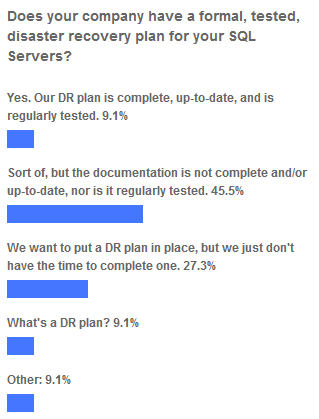
This past month I ran a poll asking this question: “Does your company have a formal, tested, disaster recovery plan for your SQL Servers.” While this was not a scientific poll, nor do I purport that it is representative of the real world, the results are still scary.
As you can see, only about 9% of responders said they have in place a complete, up-to-date, and tested DR plan. And another 9% said that they didn’t even know what a DR plan was.
About 45% said they “sort of” have a DR plan, but it is not complete and/or up-to-date, nor is it regularly tested. And then about 27% said that they wanted to put a DR plan in place, but that they just didn’t have time to complete one. The 9% who answered “other” were consultants, and the question didn’t really apply to them.
It’s disconcerting to think that only about 9% of companies have a valid DR plan, 45% have a “sort-of” plan, and another 36% have no plan at all.
 Brad M McGehee